A monogram pattern can do more than decorate a surface. When motif, spacing and repeat are resolved with discipline, it gives a product a recognizable visual language before the customer reads a label. That is why monograms continue across fashion, accessories, textiles, packaging and interiors: they connect identity with ornament.
For buyers, the visual idea is only half the decision. A convincing luxury monogram pattern must also work as production artwork. The repeat needs to disappear across fabric yardage, the scale must suit the product, and the selected rights must cover the intended use. A beautiful tile that fails at the join is not premium pattern design.
This guide examines monogram patterns from both sides of the studio table: their cultural association with distinction and their practical value as seamless surface patterns. It is written for fashion designers, textile teams, interior brands, manufacturers and licensing buyers comparing artwork for a commercial collection. To see the visual directions discussed here, explore the Luxury Monogram collection or browse the wider Art Pattern Studio shop.
What Is a Monogram Pattern?
A monogram is a compact mark formed from one or more letters, initials or symbolic elements. In its simplest form, it identifies a person, household or organization. In surface pattern design, that mark becomes a repeating unit: it is arranged with spacing, rhythm and supporting geometry so that it can continue across a surface without a visible beginning or end.
The strongest monogram patterns are not logos copied into rows. They are systems. The central mark may be linked by chains, framed by geometry, rotated into a lattice or balanced with secondary symbols. At a distance, the composition creates texture; at close range, individual elements become legible.
This dual reading is commercially useful. A seamless monogram can lead on a scarf, then become a quieter tonal texture on lining, packaging or wallpaper.
It is also important to separate related terms. A monogram is not technically the same thing as a family coat of arms or heraldic crest. Heraldry follows its own visual and historical rules. Monograms, royal ciphers, household marks and heraldic devices have often shared contexts of ownership, status and ceremony, but they are different forms. Understanding that distinction helps a designer draw from history without producing a vague imitation of it.
From Personal Mark to Decorative Language
Monograms predate modern branding. Initials and abbreviated names appeared on coins, manuscripts, seals, metalwork and architecture to identify origin, authority, patronage or ownership. Over time, their arrangement became increasingly decorative.
Early marks, initials and authorship
Before mass production, a personal mark could indicate who made, commissioned or owned an object. Interlocked letters compressed a name into a small field and could be engraved, stamped, embroidered or painted.
That economy remains relevant. A monogram can hold meaning in a small area, making it useful on wallets, neckties, labels and stationery. The designer must preserve clarity through repetition.
Aristocratic culture, ciphers and exclusivity
European royal and aristocratic households used ciphers, initials and emblems across correspondence, linens, furnishings and ceremonial objects. The marks communicated continuity, authority and a coordinated environment.
Family crests and coats of arms also linked repeated symbols with inherited status. A crest is not a monogram, but both made identity visible across objects and spaces. This helps explain why repeated initials still suggest provenance and exclusivity.
From ownership to visual identity
Industrial production changed the scale. A mark no longer identified one handmade object; it could organize an entire range across fabric, luggage, paper goods and decorative surfaces. The monogram moved from private ownership mark to public design language.
How Monograms Entered the Fashion Industry
Fashion gave the repeated monogram a new function. Instead of appearing only as a discreet embroidery or maker's stamp, it could cover the product itself. Luggage, handbags, scarves, linings and small leather goods were particularly suitable because their surfaces offered enough area for repetition while remaining connected to craftsmanship and travel culture.
A repeated mark also solved a practical branding problem. A placed logo can disappear when a product is folded, cropped or viewed from another angle. A seamless repeat distributes recognition across the entire surface. On a bag panel, scarf corner or garment cut piece, some part of the visual language remains present.
Monogram fabric design later expanded beyond literal initials. Letters combined with links, frames, stripes, florals and geometry, widening the range from statement print to subtle texture.
Today, black and white can feel graphic and editorial; beige and brown can suggest warm heritage; tonal cream can move toward quiet luxury. Geometry feels contemporary, while ornament supports a more expressive collection.
Why Luxury Brands Use Repeated Monograms
Luxury is not created by a motif alone. Material, construction, scarcity, service and cultural positioning all matter. Yet a well-developed monogram pattern can reinforce those signals in several useful ways.
Recognition without a single placed logo
An all-over pattern makes identity persistent. It can remain recognizable when photographed at an angle, cut into small components or used across products with different proportions. This is especially valuable for accessories, where one collection may include bags, wallets, belts, scarves and packaging.
The repeat also creates memory through rhythm. Customers do not need to study each letter. They begin to recognize the overall density, contrast and geometry.
Coherence across categories
A monogram system can connect fashion and non-fashion products without forcing every object to look identical. The hero version may appear on a silk scarf, while a reduced-scale or low-contrast variation appears on lining. The same motif can inform tissue paper, boxes, tags, wallpaper or a showroom textile.
This is one reason monogram patterns are valuable to collection planners: they create a family resemblance across touchpoints.
Controlled visibility
Monograms can be adjusted according to how loudly a brand wants to speak. Large scale and strong contrast produce a statement. Smaller scale, tonal color and more generous spacing create discretion. The motif can remain present without dominating the product.
That flexibility is central to current luxury print design. The market does not move in only one direction; expressive branding and restrained branding often coexist. A strong pattern system can support both.
Why Consumers Associate Monograms With Sophistication
The association is historical and perceptual. Repeated marks recall provenance and controlled environments, suggesting that a product belongs to a larger system.
Clean alignment communicates intention. Fine spacing, balanced density and a controlled palette can resemble woven structures or architectural grids, qualities often read as refinement.
Recognition also builds confidence: a consistent pattern feels established. An emerging label can create that consistency when its design is original rather than an imitation of protected brand identity.
Sophistication disappears quickly when execution is weak. Distorted initials, uneven spacing, accidental gaps and obvious repeat lines make the pattern feel inexpensive. The consumer may not identify the technical error, but the surface will feel less resolved.
How a Monogram Pattern Increases Perceived Product Value
Perceived value grows when the pattern supports the product rather than sitting on top of it. Scale, placement, substrate and finishing should work together.
| Product | Role of the monogram pattern | Production consideration |
|---|---|---|
| Handbags | Creates recognition across panels and product families | Test cropping around seams, pockets and hardware |
| Shirts and dresses | Turns the garment into a coordinated statement surface | Check scale on the body and match across visible seams when required |
| Scarves | Allows borders, corners and all-over fields to share one identity | Preserve detail at print size and plan edge finishing |
| Ties | Creates refined rhythm in a narrow format | Use a scale that remains legible after cutting and folding |
| Shoes | Connects small panels with the wider accessories collection | Test distortion over curved forms |
| Stationery | Extends identity into correspondence and presentation | Maintain clarity at small scale and on uncoated papers |
| Home decor | Adds a signature surface to cushions, bedding and upholstery | Evaluate repeat size from room-view distance |
| Wallpaper | Builds an immersive branded or decorative environment | Test seams, wall width and installation direction |
| Premium packaging | Makes the unboxing experience part of the visual system | Coordinate outer box, tissue, ribbon and labels without overuse |
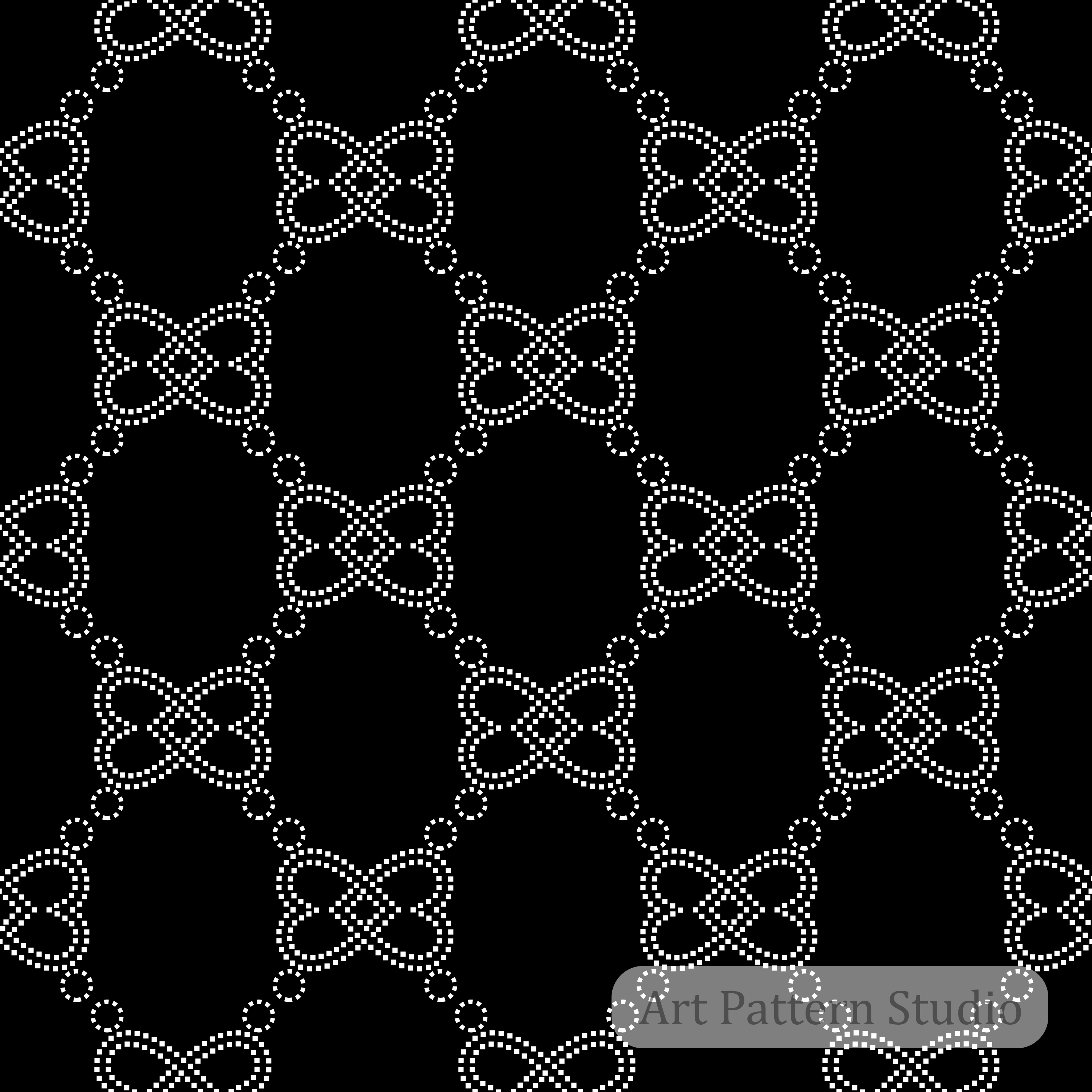
The Luxury Monogram Chain Seamless Pattern in Black and White illustrates a graphic direction suited to accessories, packaging and contemporary fashion surfaces. By contrast, the Beige Luxury Monogram Seamless Pattern supports a warmer, quieter palette for interiors, travel-inspired accessories and coordinated lifestyle products.
The Seamless Repeat Is the Technical Foundation
A seamless pattern is a tile whose opposite edges connect perfectly. Repeated horizontally and vertically, its joins disappear and the viewer perceives one continuous surface.
For a monogram pattern, this is more demanding than placing symbols at random. Letters and geometric links naturally create alignments. If one interval is slightly wider, or a diagonal fails to continue, the eye finds the fault quickly.
Invisible joins and controlled rhythm
A professional repeat considers several relationships at once:
- motifs crossing the left edge must continue precisely on the right;
- motifs crossing the top must continue on the bottom;
- spacing should remain consistent through the tile boundary;
- diagonals and chains must preserve their angle;
- negative space should not create accidental stripes or empty channels;
- repeated clusters should not form unintended blocks.
Symmetry versus mechanical repetition
Symmetry is useful in luxury surface patterns because it creates order. Too much symmetry, however, can make the tile look mechanical. A sophisticated repeat often balances structure with variation: a clear lattice may contain changes in orientation, weight or internal detail.
The goal is not to hide repetition completely. Pattern depends on recurrence. The goal is to prevent the tile boundary from interrupting the design.
Professional scale testing
A repeat should be tested in three views:
- Tile view, to inspect edge connections and construction.
- Yardage or wall view, to identify stripes, gaps and obvious blocks.
- Product view, to see how the artwork behaves after cutting, folding and cropping.
This process is described in How to Choose Seamless Patterns for Fashion Collections. For monograms, the product test is essential because identity-bearing elements must remain balanced in a small crop.
What Happens When a Repeat Is Poorly Built
A flawed repeat often looks acceptable as one square on screen. The problems appear only after duplication or printing.
Common failures include:
- a vertical or horizontal line where tile edges meet;
- one gap that repeats at regular intervals;
- chains or diagonals that break at the boundary;
- motifs that collide or sit too close after tiling;
- a dense cluster followed by an empty area;
- obvious square blocks across wide fabric;
- partial letters that create confusing shapes;
- inconsistent scale between the repeat and product;
- raster edges that become soft or pixelated in large-format printing.
On fabric, these errors multiply across every meter. On wallpaper, a mismatch appears at each drop. Correcting the issue after sampling can require rebuilding, recoloring and approving the artwork again.
How a Professional File Saves Production Time
A production-ready file lets a supplier understand the tile, test scale and prepare output without reconstructing the artwork.
Vector artwork is useful when recoloring, scaling and separating elements. An organized EPS can be enlarged without pixelation. High-resolution raster files remain valuable for mockups and digital printing.
File quality also includes less visible details:
- a clearly defined repeat tile;
- clean paths and closed shapes where appropriate;
- manageable anchor points;
- intentional color values;
- no hidden stray objects;
- no unnecessary clipping structures;
- useful naming and export settings;
- license documentation stored with the artwork.
These details save time between approval and production and simplify communication between partners.
How International Buyers Evaluate Monogram Artwork
Professional buyers evaluate more than a thumbnail. They ask whether the artwork supports the product, customer and production method.
A fashion team may need both hero print and lining coordinate. A wallpaper company examines repeat dimensions and room-scale rhythm. An accessories buyer tests small-panel cropping. A licensing team confirms territories, quantities and file access.
Strong buyers also consider differentiation. Original design can feel luxurious without borrowing another company's recognizable letterform, emblem or repeat structure.
The Black and White Luxury Monogram Pattern No.005 offers a monochrome direction that can be recolored for different collection stories, subject to the included file format and selected license. The Luxury Monogram Pattern 006 in Beige supports a softer neutral application for textiles, wallpaper and premium decor.
The Role of the Surface Pattern Designer
A surface pattern designer works between visual concept and manufactured surface. The role requires understanding how repetition changes perception, scale changes meaning and material changes color.
For monograms, the designer manages hierarchy. Which element carries identity? Does the pattern read as mark, texture or both? Can it move from wallet to wall without losing character?
Experience appears in simple decisions: motif distance, link angle, negative space and the point where a letter becomes abstract. They determine whether the surface feels composed or merely repeated.
At Art Pattern Studio, that perspective is informed by more than 15 years of experience across fashion, textile development and digital pattern creation. The objective is not to produce ornament in isolation, but artwork that can move into real creative and commercial workflows. Learn more on the About the Founder page.
Professional Monogram File Checklist
Before licensing a monogram pattern, review:
- Perfect repeat: opposite edges connect without visible lines or broken motifs.
- Yardage test: the tiled artwork does not create accidental gaps, stripes or blocks.
- High resolution: raster files are large enough for the intended output.
- Vector format when possible: scalable artwork supports recoloring and size changes.
- Organized construction: paths, groups and colors can be understood by the production team.
- Useful scale: the motif remains effective on the intended product.
- Color flexibility: the artwork can support the planned palette and printing method.
- Clean exports: preview and production files do not include stray marks or accidental transparency.
- Product testing: the pattern has been reviewed on realistic templates or samples.
- Appropriate license: usage rights match product type, quantity, distribution and territory.
If any point is unclear, ask before production. A short technical question is less costly than rebuilding approved artwork.
Where Monogram Patterns Can Be Used
Fashion and accessories
Monograms work on scarves, shirts, dresses, ties, linings, luggage, handbags, wallets and footwear. A scarf can support an elaborate field, while a tie or wallet usually needs a tighter repeat.
The Luxury Monogram Seamless Pattern No.001 is positioned for fashion branding, scarves, accessories, premium packaging, wallpaper, textiles and home decor. Its warm runway-oriented presentation demonstrates how a repeated surface can move from flat artwork into a styled collection context.
Textiles, wallpaper and home decor
In interiors, repeated geometry works on wallpaper, cushions, bedding and upholstery. Tonal color can add structure without overwhelming the room. Large samples reveal whether a laptop-scale repeat creates calm rhythm or visual noise on a wall.
Stationery and premium packaging
On paper goods, a monogram may cover wrapping paper, detail an envelope or add texture to a rigid box. Coordinated scales create a premium unboxing experience without making every component identical.
Current Monogram Pattern Directions
Minimalist monograms
Minimalist versions give the core mark more space. Thin lines, controlled geometry and limited palettes suit contemporary apparel, cosmetics packaging and stationery.
Geometric monograms
Geometric structures use grids, diamonds, chains or interlocking frames. They feel architectural, work well in black and white and translate across product sizes.
Organic monograms
Organic directions soften the grid with curves, hand-drawn movement or botanical references. The repeat must remain precise; organic does not mean technically loose.
Retro and heritage-inspired monograms
Retro monograms may use ornamental frames, warm browns, cream or decorative symmetry. Strong examples reference a period without reproducing another brand's visual property.
Contemporary graphic monograms
High contrast, oversized scale and bold cropping create an editorial direction for statement accessories, fashion capsules and graphic interiors.
Quiet luxury and tonal surfaces
Quiet luxury changes the monogram's volume rather than eliminating it. Tonal beige, cream, charcoal or near-black can create texture through light, weave and proximity, but still needs enough contrast to reproduce reliably.
A Practical Luxury Monogram Product Matrix
| Pattern | Visual direction | Strong applications | Buyer consideration |
|---|---|---|---|
| Luxury Monogram Chain – Black & White | Graphic, contemporary, high contrast | Handbags, scarves, packaging, editorial fashion | Test smaller crops so chain rhythm remains balanced |
| Luxury Monogram No.001 | Warm, runway-oriented luxury | Fashion, accessories, wallpaper, branding | Coordinate with neutral materials and hardware |
| Beige Luxury Monogram No.002 | Heritage-neutral, soft contrast | Travel accessories, interiors, lifestyle products | Review contrast on beige or natural substrates |
| Luxury Monogram No.003 | Brown and black statement surface | Fashion textiles, decor accents, premium products | Test print density on absorbent fabric |
| Luxury Monogram No.004 | Black-and-white geometric motif | Apparel, stationery, gift packaging | Check motif visibility after small-product cropping |
| Black and White Monogram No.005 | Refined monochrome repeat | Textiles, wallpaper, fashion coordinates | Plan recoloring before approving the full range |
| Luxury Monogram 006 – Beige | Light neutral luxury | Wallpaper, home decor, soft accessories | Use a physical sample to confirm tonal contrast |
Review the artwork on actual dimensions, material and print method before production.
Pattern Licensing for Commercial Collections
Purchasing a digital pattern does not transfer copyright. It grants usage rights according to the selected license. A personal project, a limited commercial collection and a high-volume international program do not create the same licensing requirements.
Before buying, define:
- the products that will carry the pattern;
- expected production quantity;
- sales channels and territories;
- whether a manufacturer needs file access;
- whether the artwork will appear in editable products;
- whether exclusivity or custom rights are required.
Review the current Pattern Licensing Guide and the article Commercial vs Extended Pattern License Explained before files are shared with a supplier. Licensing should be resolved during collection planning, not after production has started.
Related Reading
- How to Choose Seamless Patterns for Fashion Collections
- Commercial vs Extended Pattern License Explained
- Polka Dot Pattern Trends for Fashion and Interiors
- Explore all Art Pattern Studio collections
- Read more surface pattern design guides
FAQ
What makes a monogram pattern look luxurious?
A luxurious result comes from original design, controlled spacing, balanced scale, refined color and technically accurate repetition. Material and product construction also influence the final perception.
Is a monogram the same as a logo?
Not always. A monogram is usually built from initials or compact symbols, while a logo may use words, icons or other brand elements. In a surface pattern, a monogram becomes part of a repeating visual system.
Why must a monogram pattern be seamless?
A seamless repeat allows the artwork to continue across fabric, wallpaper or packaging without visible tile edges. Broken joins and repeated gaps become obvious over large production areas.
Which file format is best for monogram fabric design?
Vector files such as EPS are useful for scaling and recoloring. High-resolution raster files can be appropriate for digital printing and mockups. The best format depends on the production method and required editing.
Can the same monogram pattern be used for fashion and home decor?
Yes, when the design, file quality and license support both uses. Scale and color usually need to be tested separately because a handbag panel and a wallpapered room create very different viewing conditions.
Which license does a brand need for a monogram collection?
The correct option depends on production volume, product categories, distribution and file access. Review the Personal, Commercial and Extended terms on the Licensing page, and request custom guidance for broader programs.
Monogram Patterns as Long-Term Brand Assets
A well-built monogram pattern gives a product more than decoration. It can strengthen visual identity, connect categories and create a recognizable surface language across fashion, textiles, interiors and packaging.
Its value depends on equal attention to concept and construction. The motif must be original and appropriately scaled, but the repeat must also be invisible, the files dependable and the license aligned with production. When those elements work together, the pattern supports a professional finish in every application.
For designers and buyers, that is the practical definition of a premium monogram: a distinctive idea engineered to perform beyond the screen.
Wesley Silveira de Almeida
Explore Premium Monogram Patterns
Continue from research to practical sourcing with the Premium Luxury Monogram collection. Each pattern is developed for professional creative workflows and can be evaluated for fashion, textile, wallpaper, accessories, packaging and interior products.
- Seamless repeat
- Professional quality
- Ready for fashion
- Ready for textile production
- Commercial licensing available
Choose the pattern first, test it at finished-product scale, then match the usage to the appropriate license. For broader collections or custom requirements, contact Art Pattern Studio.


 No products in the cart.