
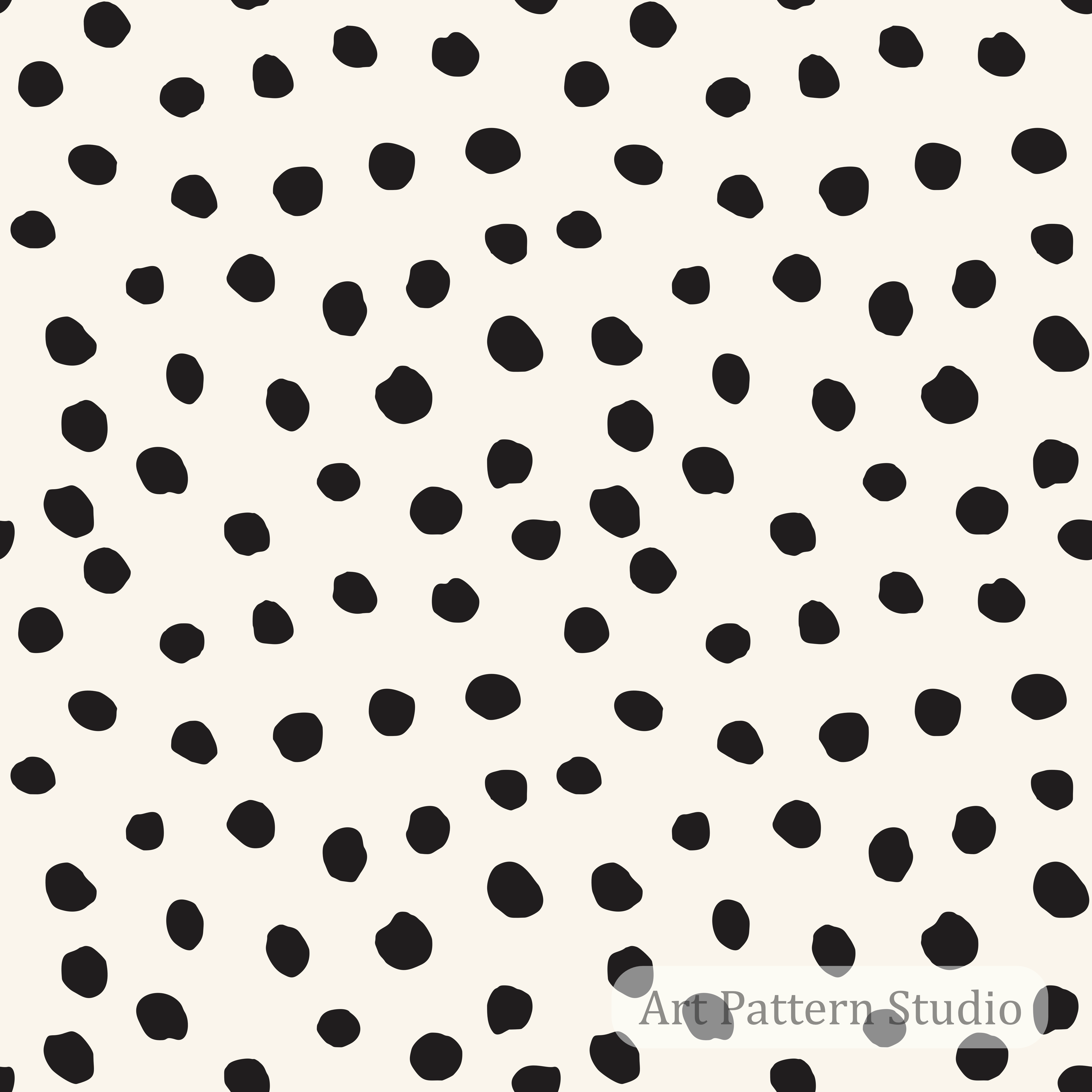
Polka dots carry an unusual amount of cultural memory for such a simple shape. A tight navy pin dot can feel almost formal; a large red circle reads as pop; an uneven black mark on warm white belongs to a more contemporary, hand-worked vocabulary. Scale and spacing do most of the storytelling.
Their renewed visibility in 2026 fashion is not a return to one fixed retro look. Runway and editorial examples range from sheer micro dots to oversized spots and playful accessories. For a print buyer, that breadth is more useful than the trend headline: it means the motif can be tuned to several markets without losing recognition.
Art Pattern Studio currently has nine designs in its Polka Dot Patterns collection, making it the studio’s largest motif category.
Why Polka Dots Have Long Commercial Life
Polka dots repeatedly return because the core geometry is easy to recognize and easy to reinterpret.
The motif moves comfortably between:
- dresses, blouses and skirts;
- scarves, bags and shoes;
- children’s products;
- stationery and packaging;
- cushions, bedding and wallpaper;
- coordinates within a textile collection.
A dot can become nearly neutral at micro scale or highly expressive when enlarged. This allows brands to use the motif at several price points and across different customer groups.
1. Refined Micro Dots
Small, evenly spaced dots are useful for products that need texture without a dominant motif. They work particularly well in shirting, linings, scarves, packaging interiors and supporting coordinates.
The visual effect depends on viewing distance. From far away, micro dots may merge into a tonal surface. Up close, they reveal more detail.
Micro-dot directions are commercially useful because they combine easily with stripes, florals, animal prints and solids.
2. Bold Retro Spots
Large dots create immediate recognition and a stronger fashion statement. They connect naturally with mid-century references, resort dressing and expressive accessories.
The Bold Retro Polka Dots Pattern is suited to statement garments, large accessories and graphic home products.
When working with oversized dots:
- evaluate how motifs cross seams;
- test crop placement on small products;
- avoid awkward partial circles near garment edges;
- compare several repeat scales.
3. Hand-Drawn and Imperfect Dots
Perfect geometry brings order; imperfect geometry brings a hand. A slightly uneven edge or irregular interval prevents the repeat from feeling mechanically polite.
The Off White Black Polka Dot Seamless Pattern offers a more organic minimalist direction. Its irregularity makes it relevant to contemporary lifestyle products, casual fashion and interiors that favor crafted surfaces.
The Red & White Hand-Drawn Polka Dot Pattern adds a stronger color statement suitable for seasonal collections and packaging.
4. Monochrome Dots as Collection Coordinates
Black-and-white dots make excellent collection punctuation. They separate more complex prints without introducing another color story and can reappear on linings, labels or packaging.
A monochrome dot might accompany:
- zebra or leopard;
- a luxury monogram;
- a large botanical;
- a tartan;
- saturated solids.
The Black & White Minimalist Polka Dot Pattern can support fashion and product collections that need a flexible secondary print.
5. Dots Across Fashion Accessories
Accessories allow brands to use polka dots without committing an entire apparel range to the motif. Scarves, handbags, shoes, hair accessories and small leather goods can carry a stronger scale or contrast.
For premium positioning:
- use controlled spacing;
- coordinate hardware and trim colors;
- consider satin, coated canvas or textured material;
- keep product shapes clean;
- create one signature scale.
The pattern can then repeat on packaging or lining to create a more complete brand experience.
6. Polka Dots for Wallpaper and Home Decor
Dots can make interiors playful or architectural. Scale is especially important.
Small dots
Useful for nurseries, powder rooms, storage interiors and subtle all-over walls.
Medium irregular dots
Appropriate for contemporary bedrooms, creative studios and casual hospitality.
Oversized dots
Best treated as a statement, with careful testing at room scale.
For a softer interior direction, off-white backgrounds often integrate more easily with wood, stone and natural textiles than pure white.
How to Choose the Right Polka Dot Pattern
Define the emotional direction
Do you want playful, romantic, retro, minimalist or dramatic? The answer determines scale, spacing and color.
Consider the customer
A children’s brand may prefer softer colors and irregular dots. A luxury accessories label may choose strict monochrome or a refined micro repeat.
Test product cropping
Mock up the pattern on actual templates. A repeat that looks balanced on a square may behave differently on a narrow scarf, sleeve or package panel.
Build related colorways
One dot system can support:
- core black and white;
- warm cream and brown;
- seasonal red;
- soft nursery colors;
- one fashion-led bright.
Confirm the license
Products manufactured for sale require appropriate commercial rights. Compare Personal, Commercial and Extended options in the Licensing Guide.
Combining Dots With Other Prints
Polka dots are strongest in a collection when their scale contrasts with the hero pattern.
Examples:
- large floral + micro dot;
- large zebra + small regular dot;
- wide stripe + irregular medium dot;
- luxury monogram + subtle pin dot;
- tartan + sparse dot.
Avoid using several patterns with the same visual density. Contrast makes the collection easier to read.
Production Considerations for Dot Patterns
Simple geometry does not eliminate the need for production testing. Perfect circles can reveal distortion quickly when fabric stretches, wraps around a curved object or moves across seams. Buyers should evaluate the pattern on the final product template rather than approving it only as a flat repeat.
For apparel, review how dots meet at side seams, darts, collars and closures. For wallpaper, check whether the repeat creates unintended vertical columns when viewed across several rolls. For packaging, test every panel and fold because a circle cropped at the wrong point can look like a printing error.
Material also changes the result. A crisp dot may remain highly defined on coated paper or smooth satin but soften on woven linen, textured wallpaper or brushed fabric. A production sample helps the team decide whether to increase scale, simplify color or adjust spacing before committing to volume.
When several products use the same artwork, create approved specifications for scale and color. This keeps a scarf, box, notebook and interior textile visually connected even when each substrate requires a different production file.
A Practical Polka Dot Product Matrix
| Product | Recommended direction |
|---|---|
| Dress | Medium or oversized statement dots |
| Blouse | Small or medium repeat |
| Scarf | Multiple scales can work |
| Handbag | Bold crop or structured monochrome |
| Packaging | Controlled small-to-medium repeat |
| Wallpaper | Test at full room scale |
| Nursery decor | Soft color and friendly spacing |
| Stationery | Small repeat or bold graphic placement |
Compare the Dots at Finished Scale
The nine designs in the Polka Dot Patterns collection range from strict monochrome to hand-drawn and retro directions. View them on a product template and compare how the spacing behaves around seams, edges and folds.
Personal, Commercial and Extended rights are available. Custom color, higher-volume and non-standard uses can be discussed with Art Pattern Studio.
Compare Polka Dots at Finished-Product Scale
Review minimalist, hand-drawn and oversized repeats across fashion, wallpaper and accessories before selecting a license.
FAQ
Are polka dots still a fashion trend?
Polka dots remain an enduring motif and received renewed runway and editorial attention in 2026. Their long-term value comes from the ability to change scale, color and spacing.
What polka dot scale works best for fabric?
It depends on the product. Small dots are versatile coordinates, while oversized dots create stronger statement garments.
Can polka dots work in luxury products?
Yes. Controlled spacing, premium materials, restrained color and refined product design can make dots feel sophisticated.
Are polka dot patterns suitable for wallpaper?
Yes, but the repeat should be tested at room scale. Large dots can dominate a space, while smaller irregular designs create texture.
What license is required for products sold commercially?
Choose Commercial or Extended rights according to production volume and distribution. Review the current Licensing Guide before purchase.
Source Patterns for Your Next Collection
Continue from editorial research to practical sourcing with relevant Art Pattern Studio products, collection pages, and licensing guidance.

 No products in the cart.